
How to Choose a Water Softener for an Apartment or Gated Community
Water Softener Guide | 8 Min Read
How to Choose a Water Softener for an Apartment or Gated Community
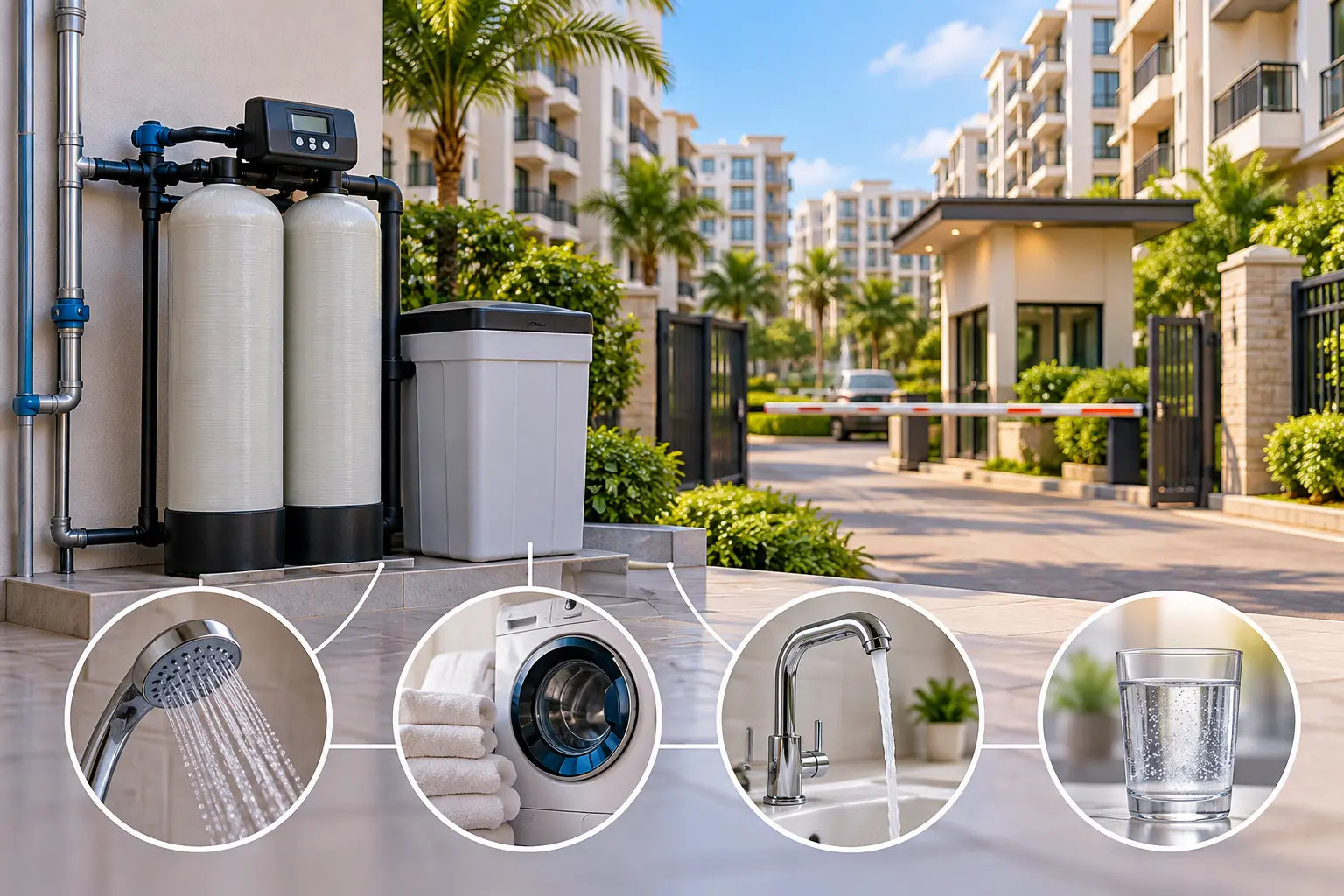
Hard water can become a larger challenge in apartments and gated communities because the same water supply may serve many homes, bathrooms, kitchens, and other water-using areas. When calcium and magnesium levels are high, scale can develop on taps, tiles, pipes, and water-heating equipment.
For a residential community, choosing a water softener should therefore begin with water testing, daily water demand, and flow requirements rather than simply selecting a system based on the number of apartments.
Why Apartments Need a Different Water-Softener Approach
A single house and a large residential community do not have the same water-treatment requirements.
An apartment or gated community may have:
- Multiple households using water simultaneously
- Higher overall daily water consumption
- Different peak-use periods
- A centralised water-supply arrangement
- Greater flow requirements
- Common plumbing and water-distribution infrastructure
A properly planned system should match the property’s actual water conditions and usage requirements.
What Should Be Checked Before Selecting a Water Softener?
The first step is understanding the water entering the property.
| Parameter | Why It Matters |
|---|---|
| Water Hardness | Identifies the level of calcium and magnesium responsible for hardness |
| TDS | Provides information about the total dissolved solids in the water |
| Iron | Helps identify whether additional treatment may need to be considered |
| Daily Water Demand | Helps determine the treatment capacity required |
| Flow Requirement | Helps determine whether the system can support the property’s water usage |
Nollet RO provides on-site water testing for parameters such as hardness, TDS, and iron before determining the appropriate treatment approach.
How Water Hardness Affects the System
Water hardness is mainly associated with dissolved calcium and magnesium.
The BIS IS 10500:2012 figures provided for this strategy specify:
- 200 mg/L as the acceptable hardness limit
- 600 mg/L as the permissible hardness limit
The actual water condition of a property should be established through testing rather than estimated from appearance alone.
This is particularly important for apartments and gated communities because the treatment requirement can vary depending on the water source and overall demand.
How Does a Centralised Water Softener Work?
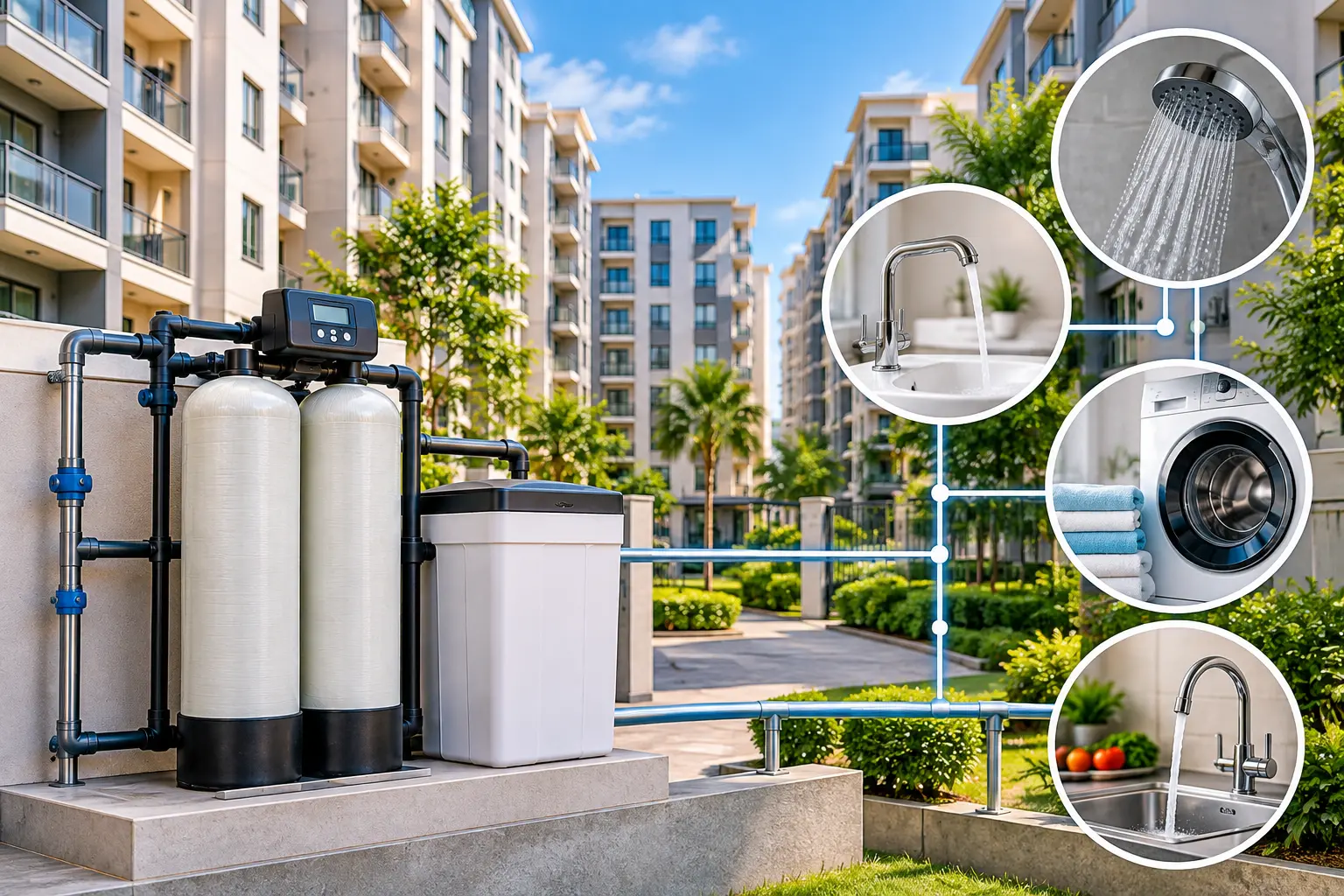
A centralised water-softening system treats water before it is distributed throughout the property.
Source Water → Water Testing → Softener → Treated Water Distribution → Apartments/Homes
Water softeners use ion-exchange resin to reduce calcium and magnesium hardness. Depending on the system configuration, automatic controls can manage the regeneration process.
For larger residential properties, the system can be designed around the building’s water demand and flow requirements.
For properties requiring a building-level solution, Nollet RO provides customised water-softening systems.
You can explore the Water Softener Plant in Adayalampattu service page to understand the type of centralised water-softening solution offered for larger residential requirements.
What Determines the Size of an Apartment Water Softener?
System size should not be decided only by the number of flats.
1. Water Hardness
Higher hardness means the system has to handle a greater hardness load.
2. Daily Water Consumption
The amount of water used by the community affects the required treatment capacity.
3. Flow Requirement
The system needs to accommodate the required water flow, particularly during periods of higher demand.
4. Resin Capacity
Ion-exchange resin provides the softening function. Its capacity needs to be considered when configuring the system.
5. Regeneration Configuration
The system should have an appropriate regeneration arrangement based on the selected configuration and operating requirements.
Apartment vs Independent Home
| Factor | Independent Home | Apartment / Gated Community |
|---|---|---|
| Water Demand | Household-level | Multiple households |
| Flow Requirement | Lower | Higher |
| Treatment Arrangement | Individual | Can be centralised |
| System Design | Property-specific | Building-specific |
| Water Distribution | Home plumbing | Common distribution network |
| Capacity Consideration | Household demand | Overall community demand |
This is why copying the specifications of a domestic softener and applying them to an apartment complex may not provide an appropriate solution.
Where Should a Centralised Softener Be Installed?
The installation point depends on the property’s existing water-supply arrangement.
A centralised system may be planned around the property’s main water-entry or distribution arrangement. The available space, plumbing configuration, water source, and operational requirements should be assessed before installation.
For properties requiring a building-level solution, Nollet RO provides customised water-softening systems.
Why Water Testing Should Come First
Choosing equipment before understanding the water can lead to an unsuitable system configuration.
A professional assessment can establish:
- Incoming water hardness
- TDS level
- Iron level
- Daily water requirement
- Required flow
- Suitable softener configuration
- Installation requirements
The result is a treatment system based on the property’s actual requirements rather than assumptions.
What About Maintenance?
A centralised water softener is part of the property’s water infrastructure, so ongoing service is important.
Maintenance considerations can include:
- Checking system operation
- Monitoring water-treatment performance
- Inspecting the control system
- Checking regeneration operation
- Assessing resin condition
- Testing treated-water hardness when required
Nollet RO also provides service and AMC support for water-treatment systems.
Frequently Asked Questions
A centralised softener can be designed to treat water for a building or residential community when the system capacity and installation arrangement are appropriate.
No. TDS and hardness provide different information. Actual hardness should be tested when evaluating a softening requirement.
Not by itself. Water hardness, daily consumption, and flow requirements also need to be considered.
Yes, a suitable centralised configuration can be planned according to the property’s water source, demand, flow, and infrastructure.
Planning Water Softening for Your Apartment or Community?
Don’t select a system based only on the number of flats or a general equipment specification.
Get the water tested first and understand the actual treatment requirement.
Contact Nollet RO for water testing and to understand the appropriate water-softening solution for your apartment or gated community.
Call Nollet RO: +91 96770 50885