
Why Does Your Water Filter Get Blocked Frequently? 7 Reasons Behind Iron Filter Pressure Loss
Introduction
Are you experiencing low water pressure after installing an iron removal filter? Does your water flow become slower over time, or does your filtration system require frequent backwashing? These problems are common in borewell water treatment systems, particularly when the source water contains high levels of iron, suspended particles, and other impurities.
An iron removal filter is designed to remove excess iron from borewell water before it reaches your household, apartment, or commercial water supply. However, improper system sizing, accumulated iron deposits, insufficient backwashing, and incorrect filter media selection can affect its performance.
Frequent filter blockage not only reduces water flow but can also affect the overall efficiency of your water treatment system. In this guide, we explore seven common reasons why iron removal filters get blocked, how to identify the underlying problems, and what maintenance practices can help maintain consistent water flow.
Why Does an Iron Removal Filter Lose Water Pressure?
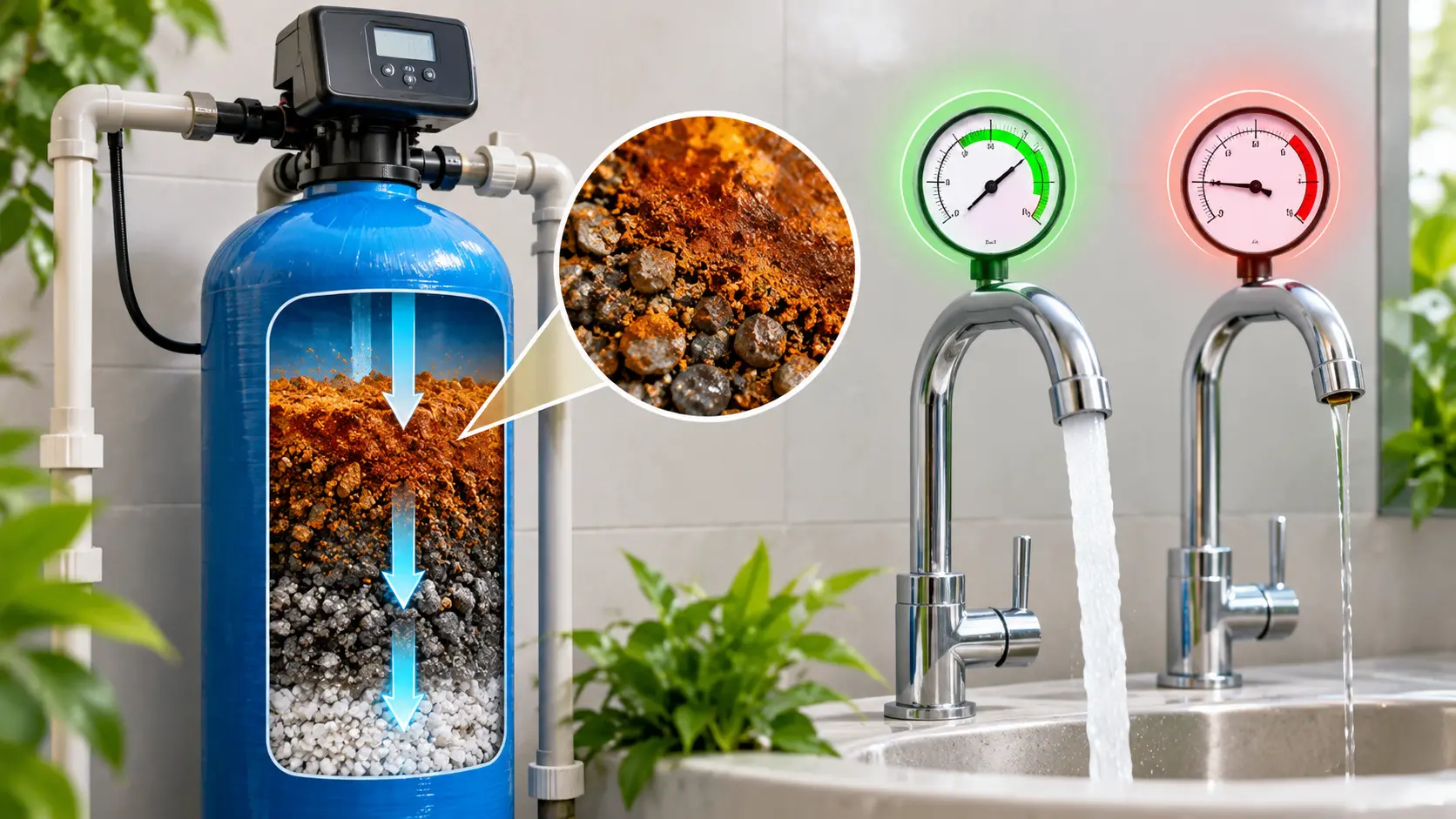
An iron removal filter may experience pressure loss when accumulated iron deposits, suspended particles, or other contaminants restrict water movement through the filter media. Insufficient backwashing, clogged internal components, and incorrect system operation can also contribute to reduced water flow.
Understanding the actual cause is important before attempting repairs or replacing filter media.
7 Common Reasons Your Iron Removal Filter Gets Blocked
1. Excessive Iron Accumulation in the Filter Media
Iron removal filters capture and retain iron particles during the treatment process. When the raw water contains a high concentration of iron, the filter media may accumulate deposits faster than expected.
Over time, these deposits occupy the spaces between the media particles and restrict the movement of water. This can lead to reduced flow, increased pressure drop, and frequent filter blockage.
Regular water testing and monitoring of filter performance can help identify excessive iron loading before it affects the entire system.
2. Insufficient Backwashing
Backwashing is an important process that cleans the filter bed by reversing the water flow and loosening accumulated impurities. If the backwashing cycle is too short, too infrequent, or performed at an unsuitable flow rate, trapped iron particles may remain inside the media.
As these particles accumulate, the filter bed becomes compacted and water flow decreases. Ensure that the backwashing cycle follows the filter manufacturer’s recommendations and is suitable for the raw-water quality.
3. High Suspended Solids in Borewell Water
Borewell water may contain sand, silt, clay, and other suspended particles. When these impurities enter an iron removal filter without adequate pre-treatment, they can collect inside the filter bed and cause blockage.
In such cases, a suitable pre-filtration arrangement may help reduce the sediment load entering the iron removal system. The appropriate arrangement depends on the actual water quality and system design.
4. Incorrect Filter Media Selection
Different iron removal media are designed for specific water conditions and operating requirements. Selecting unsuitable media for the source-water chemistry, iron concentration, or flow rate can reduce filtration efficiency.
Incorrect media selection may also make backwashing less effective, allowing iron deposits and suspended impurities to remain trapped in the filter bed.
5. Incorrect Water Flow Rate
Every iron removal filter is designed to operate within a particular service flow rate and backwash flow range. If water passes through the filter too quickly, the treatment process may not work effectively.
Excessive flow can also disturb the filter bed and affect filtration performance. The flow rate should be selected according to the vessel size, media type, and water treatment requirements.
6. Automatic Valve or Controller Malfunction
Automatic iron removal filters depend on control valves and timers to manage service, backwashing, and rinsing cycles. If the controller or valve does not operate correctly, the filter may not complete its cleaning cycle.
Faulty settings, blocked valve passages, damaged components, or power interruptions can affect automatic operation. Periodic inspection helps ensure that the system performs its programmed functions correctly.
7. Clogged Underdrain or Internal Distributor
The underdrain and internal distributor help collect and distribute water evenly inside the filtration vessel. If these components become clogged with sediment, iron deposits, or other particles, water flow through the system may be restricted.
Internal blockage may not be resolved by normal backwashing. A technician may need to inspect the internal components and identify whether cleaning, repair, or replacement is required.
How to Identify the Cause of Iron Filter Blockage
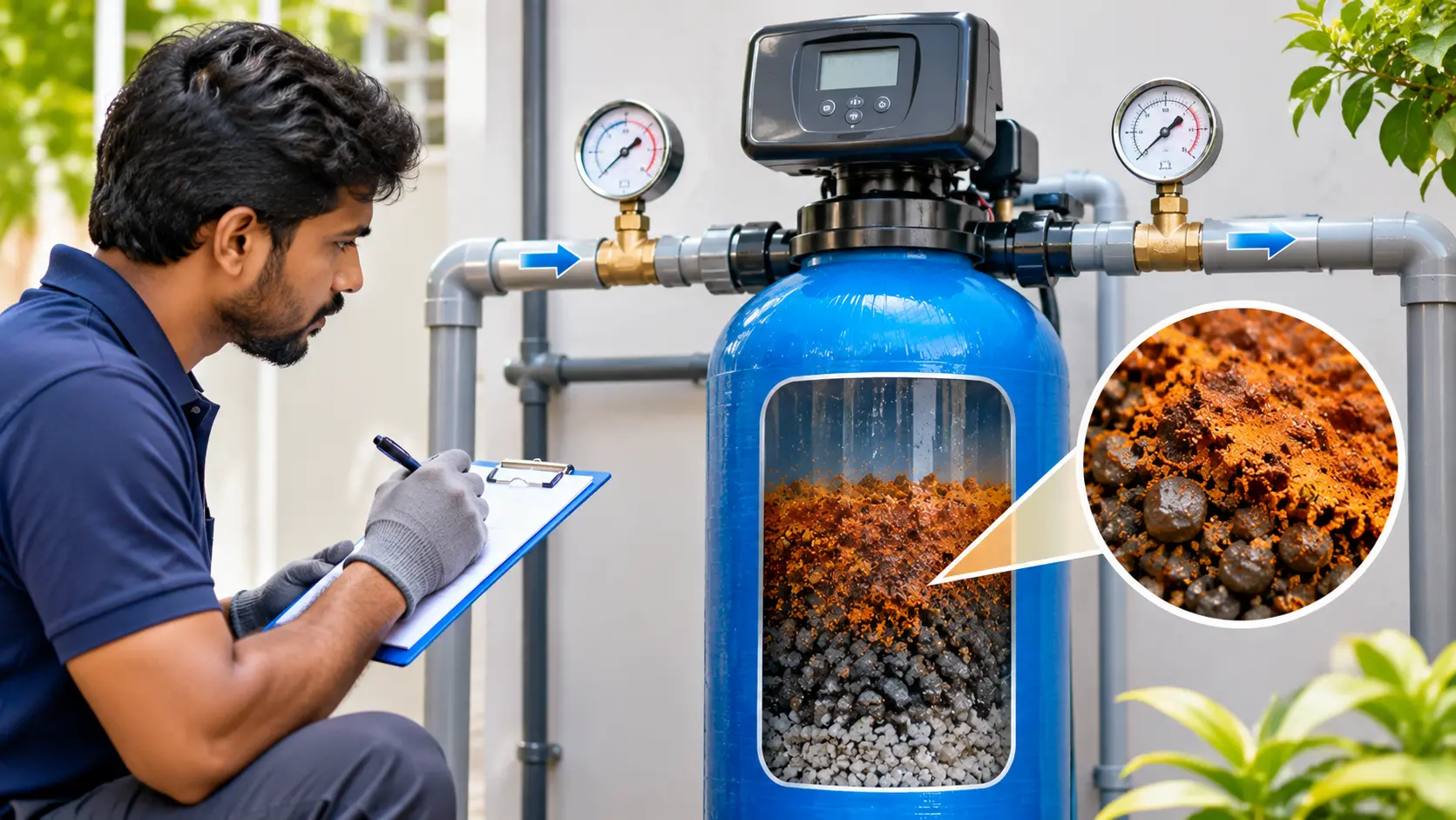
Checking the pressure difference between the inlet and outlet is one way to understand whether an iron removal filter is becoming blocked. A gradual increase in pressure difference may indicate that impurities are accumulating inside the filter bed.
Differential Pressure = Inlet Pressure − Outlet Pressure
Compare the readings with the system’s normal operating values and the manufacturer’s recommended limits.
Other symptoms can also help identify the possible cause of the problem.
| Observed Symptom | Possible Cause |
|---|---|
| Gradual reduction in water flow | Iron deposits or suspended solids accumulating in the filter media |
| Low pressure even after backwashing | Clogged underdrain, internal distributor, or pipeline restriction |
| Frequent filter blockage | High iron concentration, sediment load, or insufficient backwashing |
| Backwashing does not complete properly | Automatic valve, controller, or backwash flow issue |
| Iron staining in treated water | Unsuitable media, inadequate treatment, or excessive iron loading |
| Inconsistent water flow | Flow-rate variation, valve malfunction, or internal blockage |
These symptoms indicate possible causes, but they do not confirm the exact fault. Checking raw-water quality, pressure readings, backwash operation, and internal components can help identify the actual issue.
How to Maintain Your Iron Removal Filter for Better Performance
Regular maintenance helps prevent excessive accumulation of iron and suspended particles inside the filter bed. It also helps maintain consistent water flow and treatment performance.
Follow these maintenance practices:
- Follow the backwashing schedule: Ensure that the filter is backwashed at the recommended frequency and flow rate.
- Inspect filter media: Check for excessive deposits, media deterioration, and performance issues.
- Test raw and treated water: Periodically measure iron concentration and other relevant water quality parameters.
- Check automatic valves: Ensure timers, controllers, and valve mechanisms operate correctly.
- Inspect pipelines: Check for sediment accumulation, leakage, and plumbing restrictions.
- Maintain service records: Record maintenance activities, pressure readings, and water quality test results.
For complete borewell treatment, the filtration system should be evaluated alongside other treatment requirements. Depending on the source-water quality, additional RO water treatment solutions may be necessary for reducing dissolved salts and other contaminants.
When Should You Consider Professional Iron Filter Servicing?
Some filter problems can be addressed through routine maintenance, while others require technical inspection.
Consider professional servicing when:
- Water pressure continues to decrease despite backwashing.
- Iron staining returns after filtration.
- The automatic valve does not complete its programmed cycle.
- The filter frequently becomes blocked.
- Treated-water quality does not meet the intended requirements.
- The system produces inconsistent water flow.
A professional technician can inspect the filtration vessel, assess media condition, examine the control valve, and recommend appropriate corrective measures.
Nollet RO provides water treatment solutions for residential, apartment, and commercial requirements. Its water testing and treatment assessment services help identify suitable filtration arrangements based on actual source-water conditions.
Learn more about Nollet RO’s water treatment solutions for your property.
Frequently Asked Questions (FAQs)
1. Why does my iron removal filter get blocked frequently?
Frequent blockage can result from excessive iron accumulation, high sediment levels, insufficient backwashing, incorrect media selection, or unsuitable filtration flow rates.
2. Can backwashing improve water pressure?
Yes. Proper backwashing can remove accumulated iron particles and suspended impurities from the filter media, helping restore water flow when filter-bed fouling is the cause.
3. How often should an iron removal filter be backwashed?
Backwashing frequency depends on raw-water quality, iron concentration, suspended solids, media type, and system design. Follow the manufacturer’s recommendations and monitor filter performance.
4. Why is water pressure still low after backwashing?
If pressure remains low, the issue may involve clogged internal components, damaged filter media, automatic valve malfunction, pump problems, or restricted pipelines. A technical inspection can identify the actual cause.
5. Does an iron removal filter require regular maintenance?
Yes. Periodic inspection, backwashing checks, water quality testing, valve inspection, and filter media assessment help maintain consistent performance.
6. When should iron filter media be replaced?
Media replacement depends on the type of media, operating conditions, water chemistry, and treatment performance. Replacement should be considered when inspection and testing indicate that cleaning or normal maintenance can no longer restore effective filtration.
7. Can an iron removal filter remove all impurities from borewell water?
No. Iron removal systems are primarily designed to address iron under suitable treatment conditions. Other contaminants, including dissolved salts, hardness, microorganisms, and suspended solids, may require additional treatment processes.
Conclusion
Frequent blockage in an iron removal filter is usually a sign that something needs attention within the filtration system. Excessive iron accumulation, insufficient backwashing, suspended particles, incorrect media selection, and valve problems can all affect water pressure and filtration efficiency.
Instead of repeatedly cleaning the filter without identifying the underlying cause, it is important to evaluate the source-water quality and the overall system design.
With proper water testing, suitable filtration media, correctly configured automatic backwashing, and regular maintenance, an iron removal system can provide more consistent water treatment performance.
Contact Nollet RO for professional water testing and iron removal system assistance.
Call: +91 96770 50885
Book your free on-site water assessment and find the right treatment solution for your water supply.