
Water Softener vs. RO System: Which One Does Your Home Actually Need?
Published: September 14, 2026 | 8 Min Read
Water Softener vs. RO System: Which One Does Your Home Actually Need?
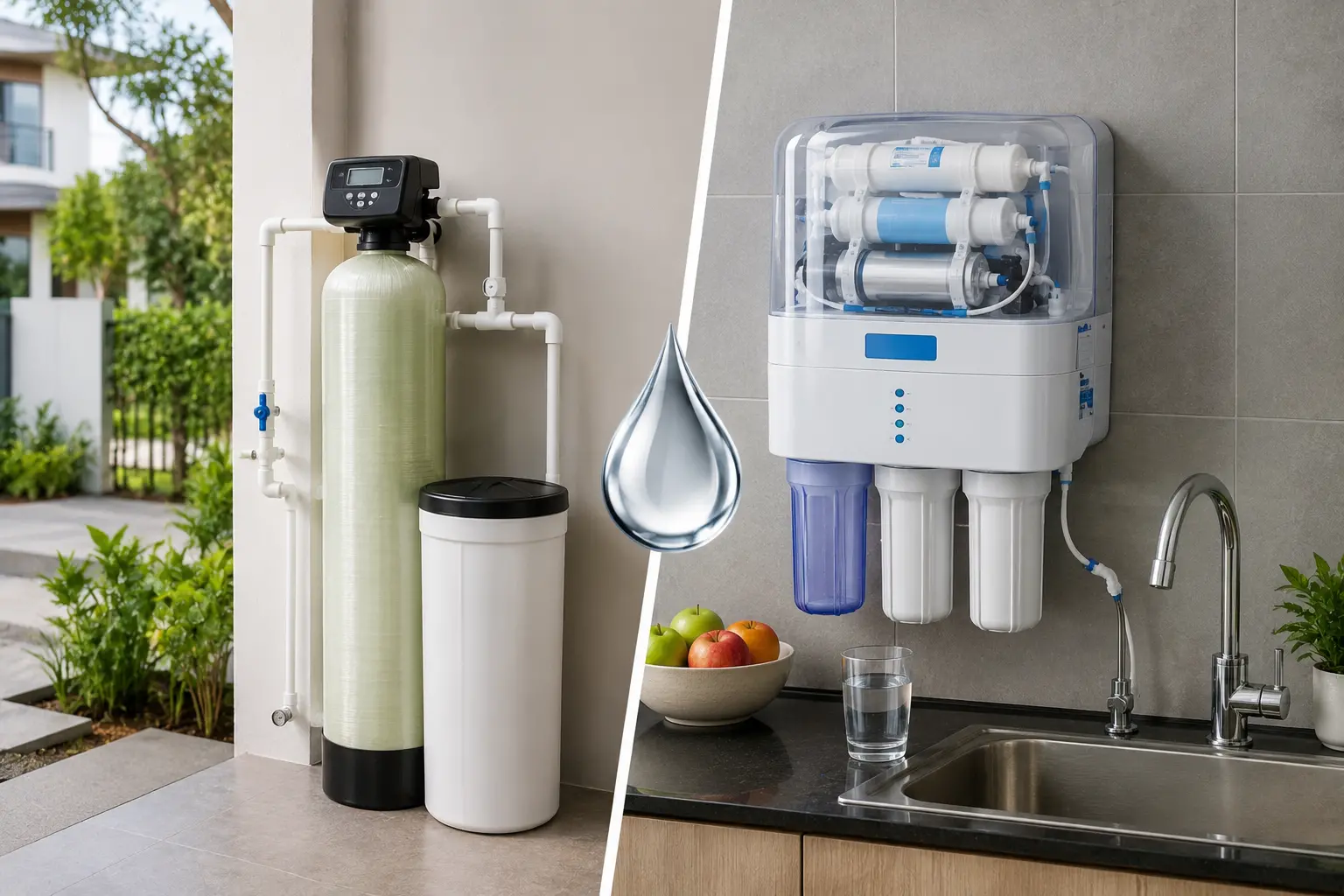
Confusion between a water softener and an RO system is common among new homeowners, renovators, and facility managers across Tamil Nadu. Both treat water, but each targets a different problem: one protects plumbing and appliances, the other purifies what actually gets consumed. Picking the wrong one, or assuming one replaces the other, often means paying twice down the line.
Quick Summary: Core Differences at a Glance
| Parameter | Water Softener | RO System |
|---|---|---|
| Target Minerals | Calcium, Magnesium (hardness) | Dissolved salts, heavy metals, TDS |
| Mechanism | Cation (ion) exchange | Semi-permeable membrane filtration |
| Primary Output | Softened utility water | Purified drinking water |
| Ideal Application | Whole-house plumbing, geysers, laundry | Kitchen tap, drinking and cooking |
| TDS Impact | Minimal to none | Significant reduction |
- White scale on taps, tiles, or low lathering: hardness is the issue; a water softener addresses it.
- Bad taste, odour, or a lab report showing high TDS: an RO system addresses it.
- Both problems present at once: a combined softener plus RO setup treats utility water and drinking water separately.
What Does a Water Softener Actually Do?
A water softener treats hardness rather than overall water quality. It targets the calcium and magnesium minerals responsible for scale buildup, soap curd, and hardness-related appliance problems across a household plumbing system.
How Ion Exchange Works: Targeting Calcium and Magnesium
Inside the softener tank, resin beads coated with sodium ions attract calcium and magnesium ions from incoming water. As hard water passes through, a sodium swap occurs: hardness minerals get trapped on the resin while sodium releases into the water stream. Periodic regeneration with common salt restores resin capacity for continued use.
What a Softener Cannot Remove
Ion exchange resin does not affect Total Dissolved Solids, bacteria, viruses, or heavy metals. A softener can eliminate limescale and improve lathering, yet TDS, taste, and microbial safety of drinking water remain unchanged. This is the most common misunderstanding among first-time buyers assuming a softener doubles as a purifier.
What Does an RO (Reverse Osmosis) System Do?
An RO system works through pressure-driven filtration rather than chemical exchange, targeting dissolved impurities at a molecular level.
How RO Membranes Function: Lowering High TDS and Dissolved Impurities
Water is forced through a semi-permeable membrane with pores fine enough to block dissolved salts, heavy metals, and microorganisms. Purified water passes through as drinking water, while concentrated impurities get flushed out as reject water. This process directly reduces TDS, unlike softening.
Why Hard Water Damages RO Membranes if Left Unfiltered
Untreated hard water entering an RO unit causes rapid scale formation on the membrane surface, reducing efficiency and shortening membrane life. Homes with high hardness levels often need a softener or scale inhibitor installed ahead of the RO unit to protect the membrane long-term.
Key Differences: Water Softener vs. RO Purifier
Water Treatment Capacity
Softeners typically treat the full household water supply at the point of entry, covering bathrooms, kitchens, and laundry. RO units generally handle a smaller volume, dedicated to drinking and cooking needs at the kitchen tap, since treating an entire house through membrane filtration would be costly and generate excessive reject water.
Water Wastage and Efficiency
Softeners use periodic backwash cycles with salt brine for regeneration. RO systems generate reject water during filtration, with typical recovery ratios between 25 and 50 percent depending on membrane type and incoming TDS.
Health and Consumption
Softened water carries added sodium and remains unsuitable as a primary drinking source for sodium-restricted diets. RO water, once purified, is standard for daily drinking and cooking across most households.
When Are Both Systems Needed in One House? The Dual-Setup Model
Homes with both high hardness and high TDS may benefit from a combined water-treatment setup. A whole-house water treatment system usually pairs a softener at the main overhead tank inlet with an under-sink RO unit at the kitchen tap. This layout protects plumbing and appliances from scale while ensuring drinking water stays low in TDS and safe for consumption.
Verdict: Choosing the Right Setup Based on a Water Report
Scenario A: High Hardness, Normal TDS
Example: TDS normal, under 500 ppm, with hardness above 300 ppm.
A softener alone typically resolves scale, laundry, and appliance issues without affecting drinking water quality.
Scenario B: High TDS and High Hardness
Example: TDS above 1500 ppm with hardness above 400 ppm.
A softener plus RO combo becomes necessary, addressing both plumbing protection and safe drinking water in one setup.
A lab-tested water report remains the most reliable starting point for determining which system is required, as well as the appropriate capacity and configuration.
Frequently Asked Questions
No. Ion exchange resin swaps hardness minerals for sodium but does not remove dissolved solids. TDS levels stay largely unchanged after softening.
Not necessarily. Homes with low TDS and only moderate hardness may need just a softener. A water report determines whether a dual setup is actually required.
RO units are typically sized for drinking water volume, not whole-house supply. Hard water reaching bathrooms, laundry, and geysers would remain untreated without a separate softener.
Softened water retains its original TDS and mineral taste; only hardness is removed. RO water tastes noticeably lighter, since dissolved salts and minerals responsible for taste and odour get filtered out during the process.
Conclusion: Match the System to Your Water Report
This isn’t about picking whichever system sounds more advanced. It comes down to what your water report is telling you. Hardness points to a softener, high TDS points to RO, and plenty of homes across Tamil Nadu genuinely need both running together. Test first, install second, and the right setup pays for itself through fewer repairs and better water for years. Nollet RO can test your water and tell you exactly what your home needs.
Nollet RO can test your water and help determine whether your home needs a water softener, RO purifier, or a combination system.