
Water Softener Buying Guide: How to Choose the Right System for Your Home
Water Softener Buying Guide | 8 Min Read
Water Softener Buying Guide: How to Choose the Right System for Your Home
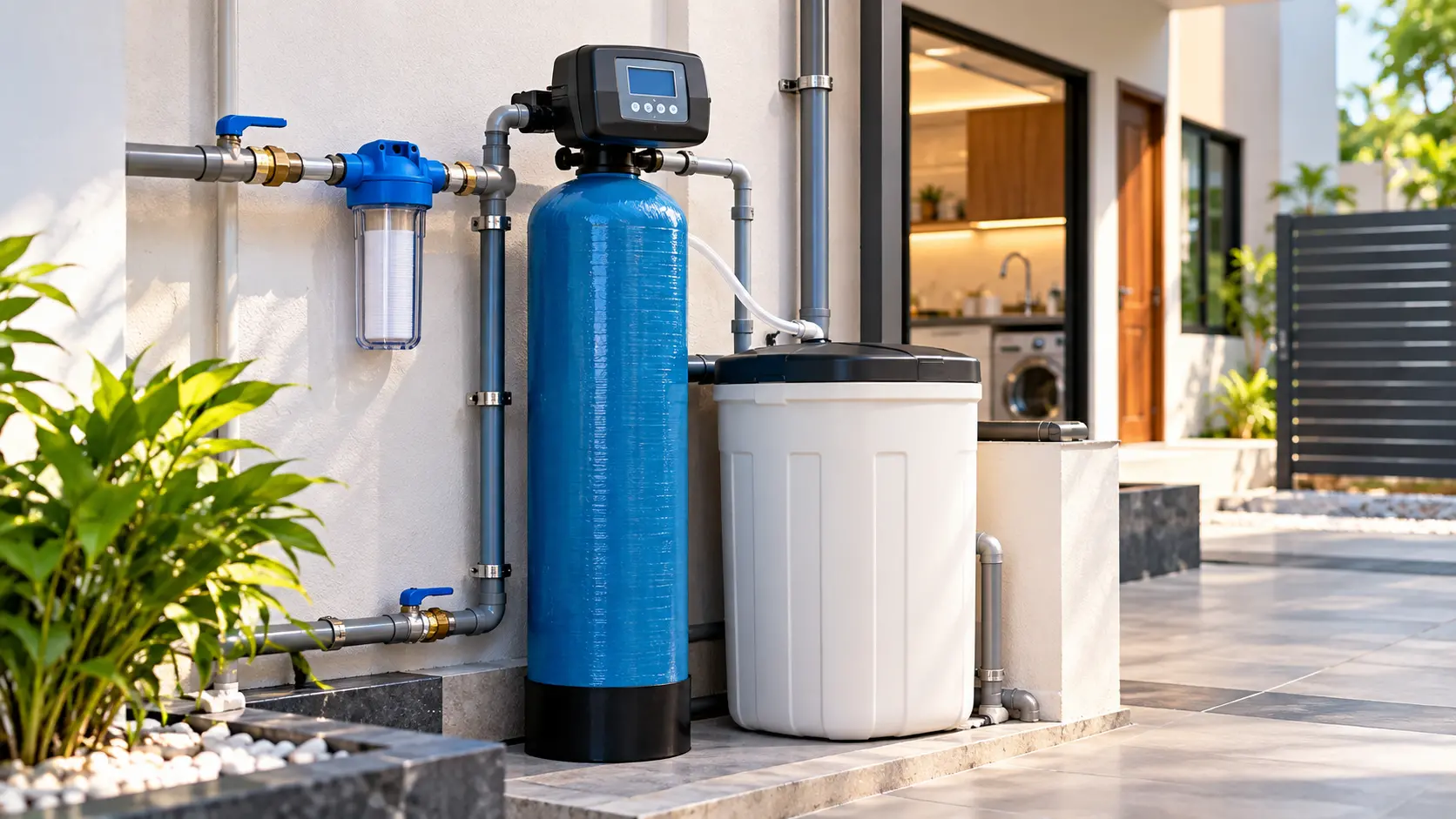
Hard water is a common concern for homes that depend on borewell or mineral-rich water. White deposits on taps, soap that does not lather properly, scaling inside geysers, and frequent appliance maintenance can all be signs of excess calcium and magnesium in the water.
However, choosing a water softener should not be based only on these symptoms. The right system depends on your water hardness, daily water consumption, flow requirements, resin capacity, regeneration method, and installation conditions.
The right water softener should be selected according to actual water hardness, household water demand, peak flow, resin capacity, and regeneration requirements. A professional water test can help determine the appropriate system.
This water softener buying guide explains what homeowners should check before selecting a system for their property.
What Is a Water Softener?
A water softener is a water-treatment system designed to reduce hardness-causing minerals, mainly calcium and magnesium. Most residential systems use ion-exchange resin, which exchanges hardness ions for sodium ions as water passes through the resin bed.
A properly selected softener can help reduce scale formation in plumbing, bathroom fittings, water heaters, washing machines, and other water-using appliances.
Do You Need a Water Softener?
Before purchasing a system, first identify whether hardness is actually the problem.
Common signs of hard water include:
- White or chalky deposits on taps and bathroom surfaces
- Poor soap lather
- Soap scum after bathing
- Scaling in geysers and water heaters
- Mineral deposits around shower heads
- Dull-looking utensils or glassware
- Increased cleaning requirements
- Hard-water-related appliance maintenance
However, symptoms alone should not determine the system size. A professional water test can identify the actual hardness level and other water-quality parameters.
What Should You Check Before Buying a Water Softener?
A water softener should be selected according to the property’s actual water conditions rather than simply choosing a larger or smaller unit.
1. Water Hardness
Water hardness is one of the most important factors in softener selection. It is generally expressed as mg/L or ppm as calcium carbonate (CaCO₃).
BIS IS 10500:2012 specifies a hardness value of 200 mg/L as the acceptable limit and 600 mg/L as the permissible limit. These values provide useful context, but actual treatment requirements should be determined from the property’s water test and intended use.
2. Daily Water Consumption
The system must be capable of treating the amount of water your household uses.
Consider:
- Number of people in the home
- Number of bathrooms
- Washing machine usage
- Geyser usage
- Kitchen and cleaning requirements
- Overhead tank capacity
Higher water consumption generally requires greater treatment capacity.
3. Peak Flow Rate
Daily water consumption is not the only consideration. A softener must also handle periods when several outlets are used simultaneously.
For example, multiple showers, washing machines, and taps operating at the same time can create a higher instantaneous flow requirement.
An appropriately sized system should provide treated water without unnecessarily restricting normal household water use.
Water Softener Selection Factors
| Factor | Why It Matters |
|---|---|
| Water hardness | Determines the hardness load the resin must handle |
| Daily water usage | Helps establish required treatment capacity |
| Peak flow | Determines the required service flow rate |
| Resin capacity | Affects how much hardness can be removed between regenerations |
| Tank size | Must match the treatment requirement |
| Regeneration method | Determines how the resin is restored |
| Installation space | Required for the treatment vessel and brine tank |
| Water source | Borewell, corporation or other sources may have different characteristics |
| Service support | Ensures continued performance after installation |
Understanding Resin Capacity
Ion-exchange resin is the core treatment media inside a conventional water softener. It captures calcium and magnesium ions and releases sodium ions.
The resin has a finite exchange capacity. Once the available capacity is used, the resin needs to be regenerated using a brine solution.
This means system selection should consider both water hardness and the quantity of water being treated.
Hardness Load = Water Consumption × Water Hardness
Actual system sizing should also account for resin specifications, operating conditions, regeneration efficiency, and peak demand.
Automatic vs Manual Regeneration
Another important consideration is how the system regenerates its resin.
Manual Systems
Manual regeneration requires the user or operator to initiate and manage the regeneration process.
Automatic Systems
Automatic systems use a control valve to manage regeneration according to a programmed schedule or water usage. Some advanced systems use demand-initiated regeneration based on the volume of water treated.
Nollet RO’s current systems include automatic regeneration configurations and sizing based on water demand and hardness.
For busy households, automation can reduce the amount of routine intervention required.
Where Should a Home Water Softener Be Installed?
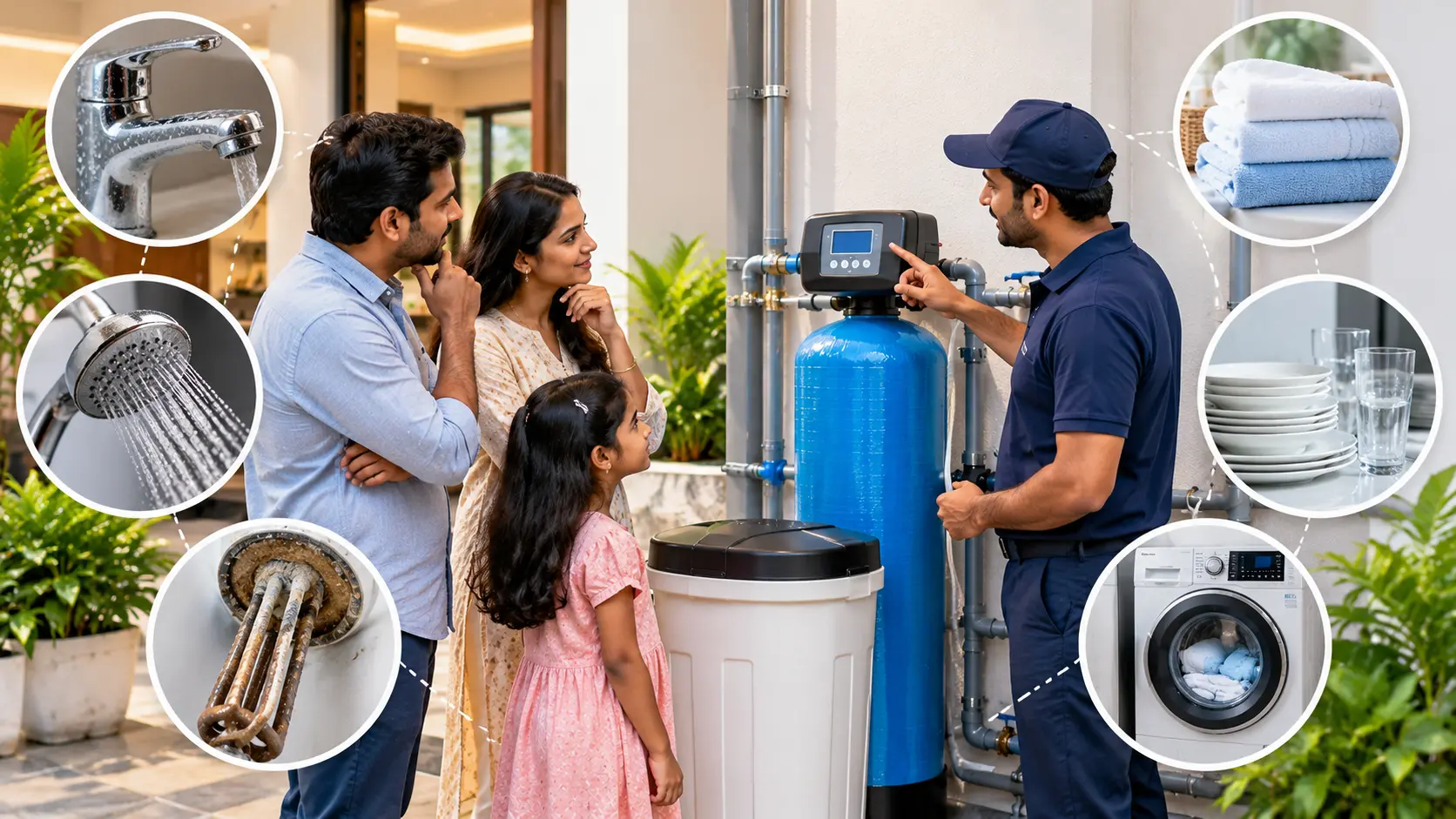
For whole-house treatment, the softener is generally installed at an appropriate main water inlet or building entry point, allowing treated water to reach multiple household outlets. Nollet RO’s residential installations describe main-inlet installation with system sizing based on hardness and daily demand.
The installation area should provide sufficient space for:
- Softener vessel
- Brine tank
- Control valve
- Inlet and outlet connections
- Drain connection
- Maintenance access
- Bypass arrangement
For homes with borewell water containing both hardness and iron, water testing is especially important because pretreatment may be required before the softening stage.
What Should You Ask Before Choosing a Water Softener?
Before finalizing a system, ask the supplier:
- What hardness level was used for sizing?
- What daily water consumption was considered?
- What peak flow rate can the system handle?
- What type and quantity of resin are being used?
- How does regeneration work?
- Is regeneration automatic?
- What installation space is required?
- Is a bypass arrangement included?
- What maintenance is required?
- Is after-sales service available?
These questions help you compare systems based on actual technical requirements instead of appearance or capacity claims alone.
Water Softener Installation for Your Home
Once the water quality and household requirements are understood, professional installation becomes the next important step. A properly configured water softener installation in Kundrathur should be based on water testing, system sizing, installation conditions, and commissioning.
For homeowners comparing different treatment options, a whole-house water softener system can provide centralized hardness treatment for household water use.
If you are unsure whether your water problem is hardness, iron, or a combination of both, professional testing should come before purchasing equipment. Nollet RO’s service process includes testing hardness, TDS and other relevant parameters before system selection.
Frequently Asked Questions
The required size depends on water hardness, daily water consumption, peak flow rate, resin capacity, and regeneration requirements. A water test and household usage assessment should be completed before selecting the system.
A conventional ion-exchange water softener is designed primarily to reduce calcium and magnesium hardness. It should not be considered a general TDS-reduction system like RO.
Yes, water softeners can treat borewell water when hardness is the issue. If the water also contains significant iron or other contaminants, additional treatment may be required before or alongside softening.
Automatic regeneration can make operation more convenient because the system manages its regeneration cycle without requiring the homeowner to manually initiate every cycle.
Yes. A correctly sized whole-house system can be installed at the main inlet so that multiple household outlets receive treated water. The system should be sized according to the property’s water demand and flow requirements.
Choose the Right Water Softener Based on Your Water
A water softener should not be selected simply by house size or by copying a system installed at another property. Water hardness, daily consumption, peak flow, resin capacity, regeneration method, installation space, and water quality should all be considered together.
The best starting point is a professional water assessment. Nollet RO provides on-site water testing and system sizing based on actual water conditions and household requirements.
Book a Free On-Site Water Hardness Test with Nollet RO or call +91 96770 50885 to discuss the right water softener for your home.