
Borewell Hard Water in Chennai: Causes, BIS Standards, and How to Fix It at Home
Published: September 7, 2026 | 8 Min Read
Borewell Hard Water in Chennai: Causes, BIS Standards, and How to Fix It at Home
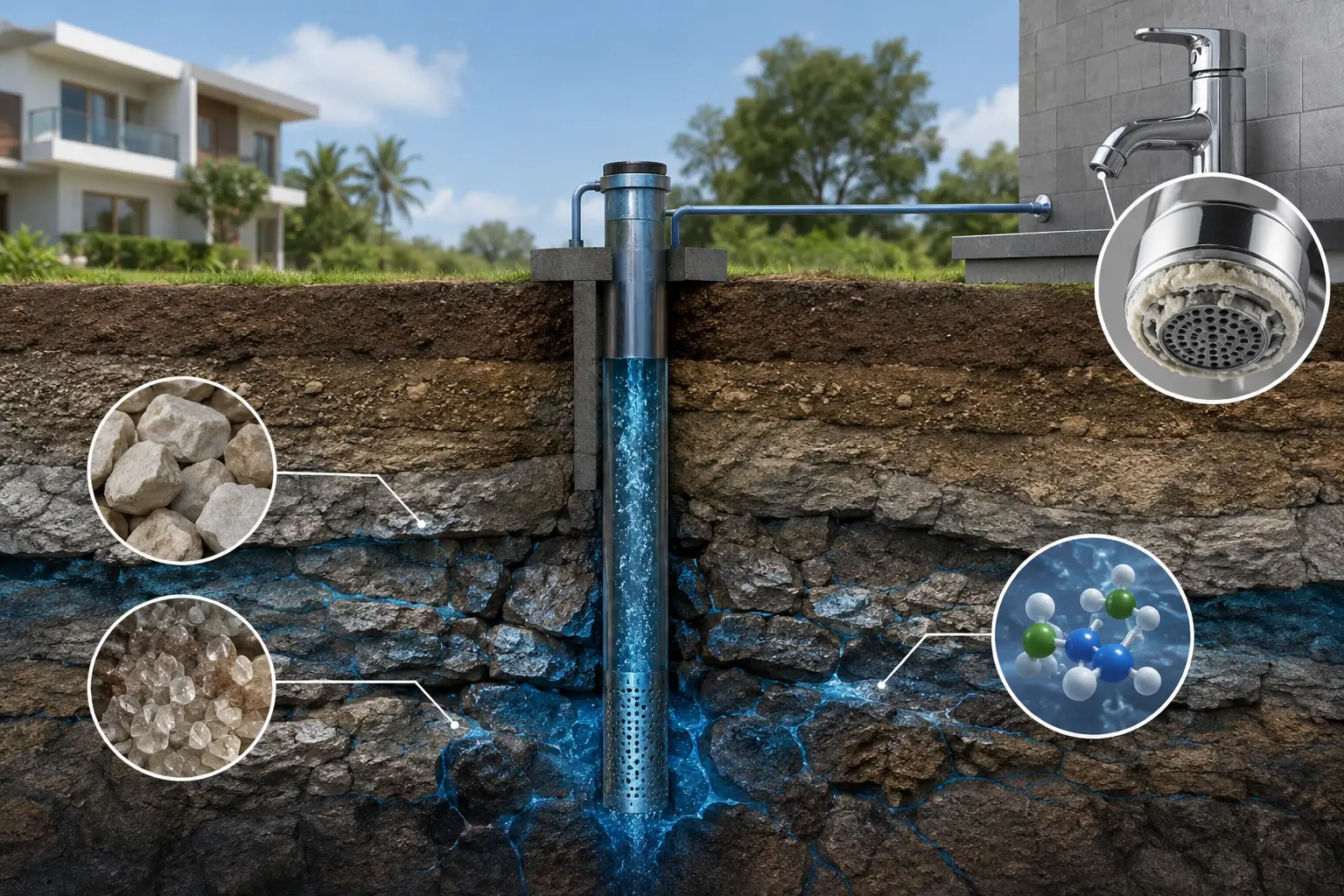
Hard water contains high levels of dissolved calcium and magnesium, measured as Total Dissolved Solids (TDS). Under BIS IS 10500:2012, the acceptable hardness limit is 200 mg/L, with a permissible limit of 600 mg/L. Many Chennai borewells test between 400 and 1200 mg/L, well above safe household standards.
What Causes High Water Hardness in Chennai’s Borewells?
Groundwater across Western and Southern Chennai, including Kundrathur, Porur, Avadi, Tambaram, and parts of OMR, passes through sedimentary rock layers rich in calcium carbonate (CaCO₃) and gypsum deposits. The Chennai aquifer system, composed largely of charnockite and sedimentary rock, dissolves these minerals as groundwater moves through fissures over time.
As borewell depths increase, in response to falling water tables across the city, extracted water travels through deeper, mineral-dense strata, picking up higher concentrations of calcium and magnesium before reaching the surface. Neighborhoods drawing water from 200+ feet frequently report hardness readings on the higher end of the Chennai range, often bordering the permissible ceiling. A water hardness assessment confirms where a property falls on this scale.
Two Types of Hardness Affect Chennai Households
- Temporary Hardness: Caused by dissolved bicarbonates, which can be partially reduced through boiling.
- Permanent Hardness: Caused by chlorides and sulfates of calcium and magnesium, which boiling cannot remove. This is the dominant form found in most Chennai borewell samples.
Permissible Water Hardness Limits as per BIS IS 10500:2012
| Category | Hardness Limit (mg/L as CaCO₃) |
|---|---|
| Acceptable Limit | 200 |
| Permissible Limit (no alternate source available) | 600 |
| Typical Chennai Borewell Range | 400 – 1200 |
Most independent houses and villas relying solely on borewell supply fall into the “permissible or exceeded” category, meaning the water is technically usable but carries long-term risks for plumbing, appliances, hair, and skin. Areas like Porur and OMR, where borewells remain the primary source without consistent Metro Water connections, sit closer to the upper end of this range, making hardness treatment less an upgrade and more a necessity for daily use.
5 Warning Signs of Severe Hard Water at Home
1. Stubborn White Scale Deposits on Chrome Taps and Tiles
Calcium buildup leaves chalky white residue around taps, showerheads, and bathroom tiles, often resistant to regular cleaning.
2. Persistent Hair Fall, Dry Scalp, and Skin Irritation
Mineral deposits coat hair strands and clog pores, frequently linked to increased hair fall, dryness, and itchy scalp conditions reported across Chennai households.
3. Low Lathering and Excessive Detergent Consumption
Hard water reacts with soap to form insoluble curd instead of lather, resulting in higher soap and detergent usage for the same cleaning result.
4. Frequent Geyser Element and Washing Machine Heating Failures
Scale buildup insulates heating elements, forcing appliances to work harder. This is a common cause of early geyser and washing machine breakdowns in hard water zones, and a leading reason households look into whole-house water softeners.
5. Decreased Water Pressure from Scaled Pipelines
Limescale gradually narrows pipe diameter, reducing flow and water pressure throughout the plumbing system over a few years.
- White furring visible on tap nozzles or shower heads
- Skin feels tight or dry immediately after bathing
- Soap forms curd or scum rather than lather
- Utensils and glassware carry a dull, spotted finish after washing
- Geyser or washing machine has needed heating-element repair in the past year
Three or more checks indicate that testing the actual hardness level is worthwhile. A professional water hardness test can determine whether the supply is above the 600 mg/L permissible level.
How to Test Water Hardness at Home: DIY vs. Lab Testing
DIY Soap Shake Test
Add a few drops of liquid soap to a bottle of borewell water and shake vigorously. Minimal foam and cloudy residue can point toward elevated hardness, although this method provides only a rough indication.
Professional Titration Test
An on-site EDTA titration test delivers an exact hardness value in mg/L. This allows the result to be compared against BIS IS 10500:2012 thresholds and helps determine the appropriate water softener capacity.
The Long-Term Solution: Whole-House Water Softeners Explained
Point-of-Entry (POE) ion-exchange water softeners are installed at the main water inlet, treating water before it reaches the overhead tank.
Inside the unit, ion-exchange resin swaps calcium and magnesium ions for sodium ions. This delivers softened water to every tap, geyser, and appliance in the house rather than treating only the kitchen supply.
A single-point installation helps reduce limescale buildup at the source, protects appliances, and addresses the effects of prolonged hard-water exposure on everyday household use.
Periodic resin regeneration using common salt keeps the system operating effectively with routine maintenance.
Book a Free Water Hardness Test →
A quick on-site check can confirm the hardness level and help determine the appropriate softener capacity for your Chennai property.
Frequently Asked Questions
Boiling only reduces temporary hardness caused by bicarbonates. Permanent hardness from chlorides and sulfates remains unaffected by boiling and requires an appropriate softening system.
RO purifiers treat drinking water at a single point, typically the kitchen. Hardness in bathing, laundry, and geyser water continues untreated. A whole-house softener is designed to address hardness across the plumbing system.
Standard ion-exchange softeners need salt refills every few weeks depending on household water consumption and incoming hardness levels. Resin replacement is generally required only after several years, depending on operating conditions.
Conclusion
Borewell hardness is a structural reality of Chennai’s groundwater, not a temporary plumbing issue. The fix works best when it targets the water supply at its point of entry rather than a single tap. A hardness test, benchmarked against BIS IS 10500:2012, remains the clearest starting point before choosing between a softener, an RO unit, or a combination system suited to household size and borewell depth.